
JA-80PB
Service explanation for JA-80PB
1 Installation
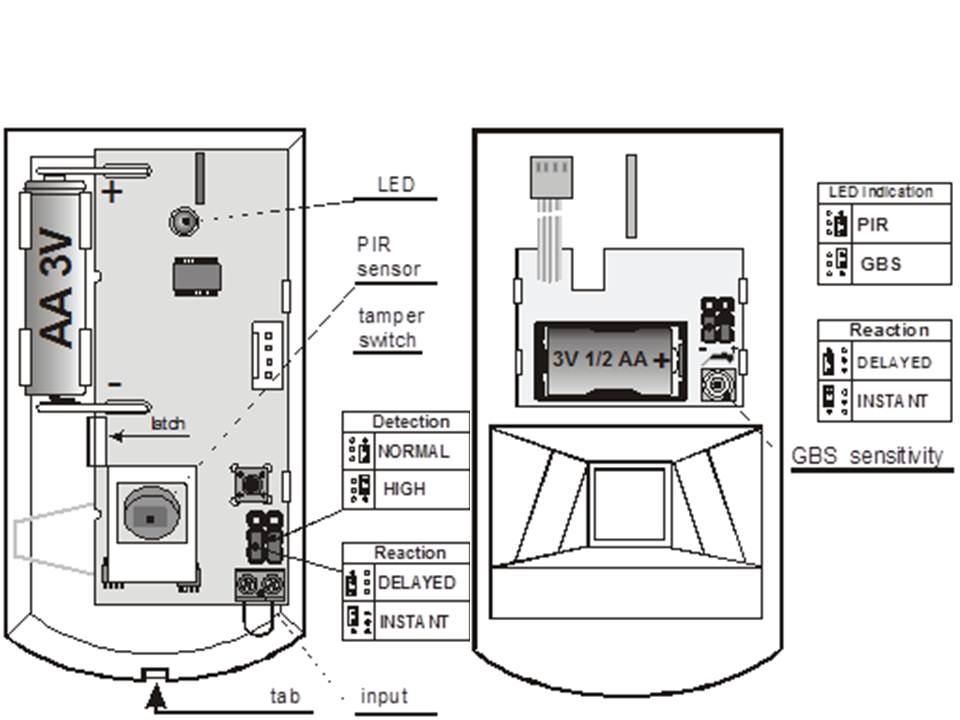
Installation should only be done by a certified technician approved by an authorized distributor. The detector can be mounted flat against the wall or in a corner. Within the detection area of the PIR there should be no objects that can rapidly change temperature such as heating, fireplace etc.
Moving objects with temperature close to that of people such as moving curtains above a heater and pets should also be avoided. Preferably do not place the detectors towards a window, spotlight or moving air such as ventilation outlets, open windows or doors. Dor the sensitivity of air pressure changes and noise, the detector should not be placed near ventilation exits or air conditioners. There should be no source of vibration or audible noise in the protection area. No objects should obstruct the detector's view. Do not place the detector near metal objects that may interfere with the wireless radio signal.
Warning: Most false alarms are caused by hanging the detector incorrectly. Do not activate the detector if there are still pets or people in the protected area.
1.Open the detector housing by pressing the tab and disconnecting the cable to the front
2.Remove the internal PIR module via the internal tab.
3.Make a hole at the screw holes in the rear housing. At least one screw must pass through the tamper-sensitive part.
4.Attach the housing to the wall about 2 feet above the floor (vertically with the tab facing down).
5.Place the PIR module back in its original location
6.Do not insert the battery yet and leave the housing open. Follow the manual of the central unit or universal receiver. Basis of learning is:
a. Enter learning mode by pressing "1" on the control panel when the system is in service mode.
b. Insert the battery in the PIR detector to learn it.
c. Insert the battery in the glass break detector and connect it to the PIR module. The glass break detector will then be taught in the next free address. This means that the glass break detector will be taught in after the PIR.
d. Exit teach mode by pressing "#".
To teach in a detector after the battery has already been inserted, first remove the battery, then press the tamper switch to discharge the detector and prepare it for teach in. After inserting the battery, allow the detector to rest for 2 minutes to stabilize. The LED then lights continuously.
2 PIR module DIP switches
NORM / HIGH: selection for immunity from false alarms. The NORM position combines good immunity with fast sensor response. The HIGH position has increased immunity and slower response time. Use this only in problematic areas.
INS / DEL. The DEL position provides and input and output delay for detectors near an input. The INS position gives immediate and alarm after activation of the detector when the system is on. This DIP switch only has an effect if in the Oasis control panel the detector is set to natural response. It also has no effect when used with a UC-8x or UC-8x universal receiver.
3 Glass Breach Module DIP Switches
DEL / INS Selects the response of the central when the detector is glass breakage detects. The DEL position provides an input and output delay and is primarily used with detectors placed at an entrance. The INS position gives an immediate alarm when the system is armed. This DIP switch only has an effect if in the Oasis control panel the detector is set to natural response. It also has no effect when used with a UC-8x or UC-8x universal receiver.
PIR/ BMS: This switch selects whether on PIR or glass break detector activation the LED is illuminated. Changing only has an effect during the first 15 minutes after closing the housing (test mode).
Note: Although the two detectors are in one housing, they work completely independently of each other. Each of the detectors has its own address in the control panel. Each of the detectors can be set independently by means of the DIP switches in the detectors or via the central unit in service mode.
4 Testing the detector
In the 15 minutes after closing the detector, the LED will flash when the glass break detector or the PIR detector is activated, depending on the setting of the PIR/GBS DIP switch. The strength and quality of the signal can be measured by the central unit in Service mode.
With the DIP switch in the position PIR the LED will flash briefly when the detector is analyzing the motion. If the LED is on for a longer period, the detector has detected motion and will transmit this information to the control center.
With the DIP switch in the position GBS the LED will flash if there are differences in air pressure, e.g. a soft knock on the window. If the LED burns longer the detector has made a glass breakage detection and will be sent to the central unit.
Testing and adjusting glass breakage detector:
- Using appropriate tools or a glove to tap against each window to be protected by the glass breakage detector. The window should visibly vibrate without causing damage.
- The deformation in the glass causes a change in air pressure in the chamber and the LED of the glass break detector should flash. The DIP switch should be in the BMS position.
- Sensitivity to air pressure changes can be set by a potentiometer on the PCB of the glass break sensor, it is on the inside of the housing. Turn clockwise to increase sensitivity and vice versa. Avoid too high sensitivity which may shorten battery life.
- The full operation of the glass breakage detector can be tested using a GBT-212 glass breakage simulator. After knocking on the glass, the simulator will play the sound of breaking glass to test the conditions of alarm activation.
If there are any sound-producing appliances in the room such as air conditioner, heater, fax machine, refrigerator, etc., check that they do not make a sound similar to breaking glass.
5 Detection characteristics of the PIR detector
The standard lens has a viewing angle of 120° and a range of 12 meters. As shown in the picture below.
The characteristics can be changed with the following lenses:
| JS-7904 | Suitable for long corridors, the middle beam has a range of 20 meters |
| JS-7906 | Has only the upper beams with a 120° angle and a range of 12 meters. Ignoring the floor allows small pets to roam freely |
| JS-7901 | Only has a vertical beam as a virtual wall, which activates the detector when someone walks through it |
Note: After replacing the lens check if it is working correctly, misplacing the lens may cause poor detection.
6 5 minutes/1 minute PIR detector sleep time
To save battery life, the PIR detector will go into a power saving mode 15 minutes after the housing is closed. In this mode, the PIR detector continuously watches for motion. If movement is detected, it will be immediately transmitted to the central unit, in thefollowing 5 minutes the detector will ignore all movement. After these 5 minutes, the detector will start watching for motion again until it is activated again. This waiting time can be shortened to 1 minute by pressing the tamper switch when the battery is inserted. By not pressing the tamper switch, the PIR has a sleep time of 5 minutes. This setting has no effect on the glass breakage detector which is always ready to detect breaking glass.
7 External alarm input
There is an alarm input in the detector which can be used, for example, to detect an open door or window. Activating this input has the same effect as the PIR detector. The maximum cable length for this input is 3 meters. Short-circuit the input when the input is not used.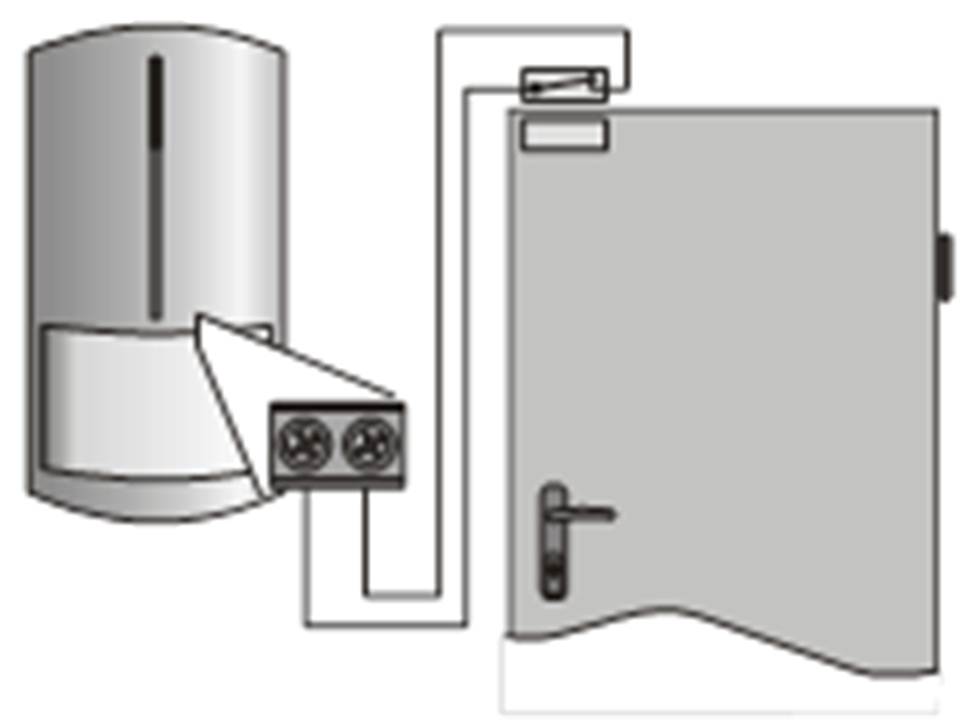
8 Detection characteristics of the glass break detector
The directional response area of the glass break detector has a bija spherical appearance. It is possible to detect breaking glass up to 9 meters far as shown in the following diagram. The window must be at least 60 by 60 centimeters in size. For smaller windows, the range of the detector is smaller. Only breaking glass that is part of the walls of the room to be protected can be detected. All types of glass can be detected including laminated glass or glass covered with an unbreakable film.
Warning: This type of detector cannot detect if a hole is cut in the glass. Valuables near windows should preferably be protected by PIR detectors.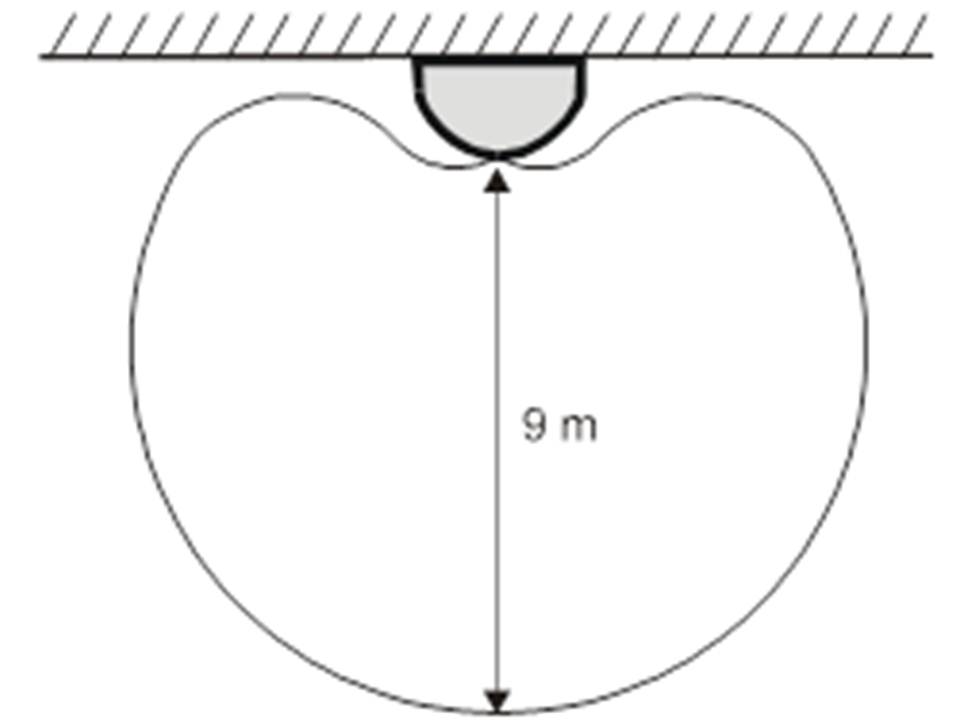
9 Replacing the battery
This detector has 2 internal batteries which are checked regularly. If one of the batteries runs low, the user and/or installer will be notified. The detector will continue to function and any movement in front of the detector will be indicated by the LED flashing. The battery must then be replaced by a qualified installer in Service mode within 2 weeks.
After replacing the battery, the detector will take about 2 minutes to stabilize, the LED will be permanently on. After replacing the battery check the operation of bijde detectors. Do not discard dead batteries, mar follow local rules for disposing of dead batteries.
10 Removing the detector from the system
When a detector is removed from the system, the panel will indicate this. The 2 addresses of the detector must be released before actually removing the detector.